Skip to content

Operating

Commercial ice-machine maintenance, honestly explained

What the work involves, why intervals are not universal, and why it gets skipped.

Short answer

What does commercial ice-machine maintenance involve?

Commercial ice-machine maintenance typically includes cleaning and sanitising the ice-contact surfaces, descaling, replacing water filters, cleaning condenser and airflow components, and inspecting for developing faults. Required frequency varies by machine, water conditions, usage and manufacturer guidance, so intervals should follow your equipment's documentation rather than a general rule.

Why this gets skipped

Almost every operator knows an ice machine needs cleaning. A great many of them are behind on it, and it is not because they do not care.

It is because maintenance has no deadline. Nobody complains, nothing stops, and there is always something more urgent this week. The consequence arrives months later as a reliability or ice-quality problem that nobody connects back to a missed service.

This is worth naming plainly, because it is the strongest practical argument for the service model. Under a lease, maintenance happens because it is somebody's contractual obligation rather than because your team found time for it during a bad month.

What the work actually involves

Specific procedures differ by manufacturer and model, but commercial ice-machine maintenance generally covers these areas.

  • Cleaning and sanitising surfaces that contact ice — this is a food-safety matter, not a cosmetic one
  • Descaling the water system, as mineral deposits accumulate wherever water is processed
  • Replacing water filters on the schedule appropriate to the equipment and water supply
  • Cleaning condenser and airflow components, since restricted airflow degrades performance
  • Checking the drain runs freely
  • Inspecting for developing faults — leaks, wear, unusual noise, declining output

Always follow the manufacturer's documented procedure for your specific equipment. Cleaning agents and methods are model-specific, and the wrong product can damage components.

Why we are not giving you a frequency

You will find cleaning intervals quoted confidently in a lot of places. We are not adding to them, because the right interval for your machine depends on things we would be guessing at.

Manufacturer guidance for your model, how hard the machine is worked, your local water characteristics, the environment the machine sits in, and any requirements specific to your industry or jurisdiction all move the answer. A number that is right for one operation is wrong for another.

If your operation is subject to health, food-safety or clinical requirements, those rules take precedence over general guidance, and they vary by jurisdiction and change over time. Work to the standard you are actually held to.

What your team can reasonably do

Even where maintenance is contracted out, day-to-day habits at your site make a measurable difference.

  • Keep the area around the machine clear so airflow is not restricted
  • Use a clean scoop, store it outside the bin, and never leave it sitting in the ice
  • Keep the bin lid closed when not in use
  • Report changes early — less ice, slower production, cloudy or off-tasting ice, new noises
  • Do not prop doors open or block vents for convenience

Ice quality is a diagnostic signal

Changes in the ice itself are often the earliest indication that something needs attention, and they are easy for staff to notice without any technical knowledge.

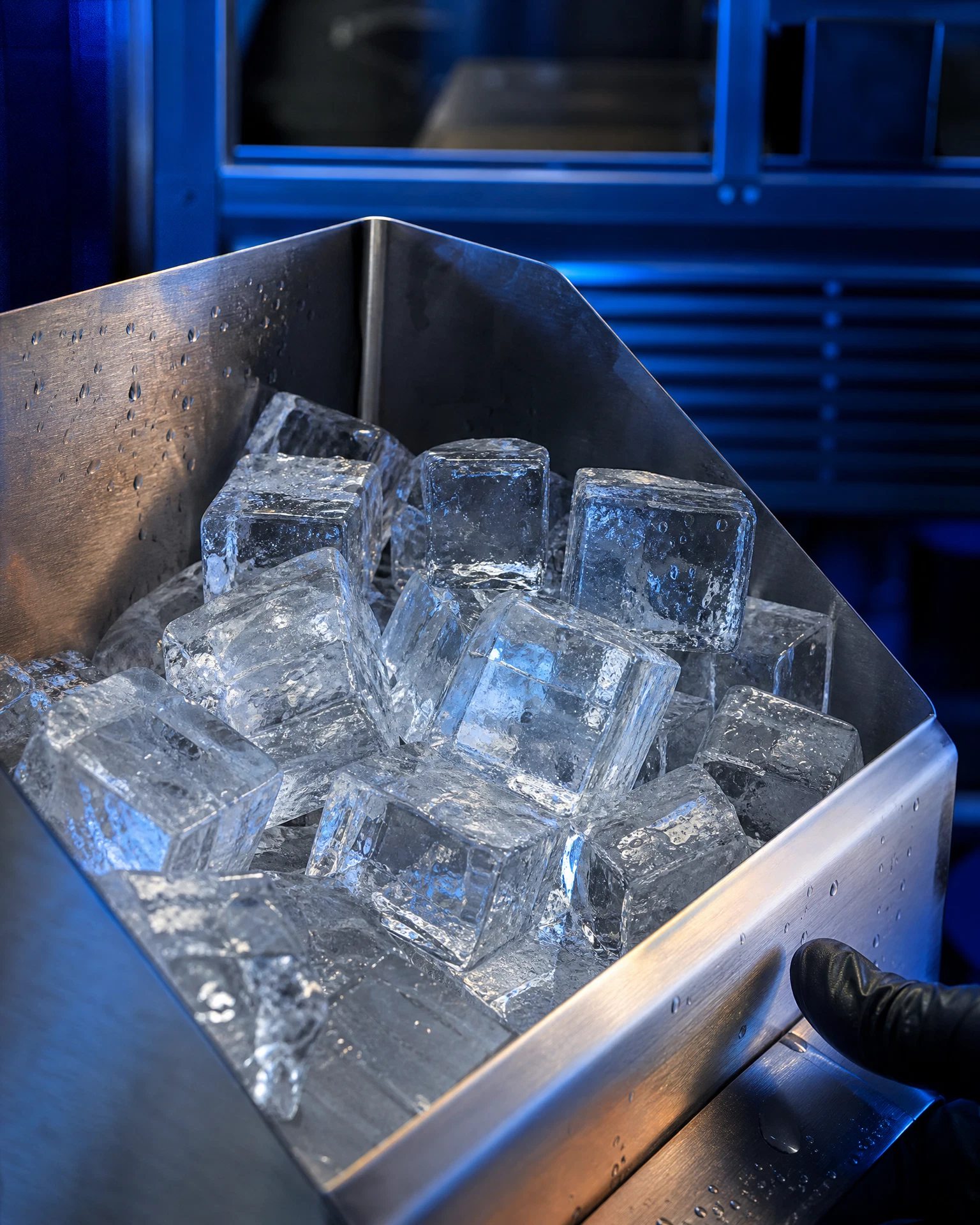
Ice that has become cloudy when it was clear, that tastes or smells different, that is smaller or misshapen, or that melts faster than it used to, is telling you something. Visible discolouration or residue anywhere in the machine warrants immediate attention rather than a note for next month.

Questions

Frequently asked

How often should a commercial ice machine be cleaned?

It depends on the machine, how hard it is used, your water supply and your manufacturer's guidance — and on any health or clinical requirements that apply to you. There is no single correct interval, which is why we will not quote one.

Can our own staff clean the machine?

Staff can and should handle basic hygiene around the machine. Full cleaning and descaling should follow the manufacturer's documented procedure with the correct products. Under a lease arrangement this is our responsibility rather than yours.

Why does our ice taste odd?

Taste and odour changes can come from filtration, cleaning needs, the water supply, or the machine's environment. It is worth reporting rather than living with — it usually indicates something that needs attention.

Does maintenance actually prevent failures?

It prevents a meaningful share of them. Many failures are gradual deterioration that became visible, rather than sudden events — which means they had a window in which they were cheaper to address.

Next step

Tell us what you serve and when you need the most ice.

No model number needed. Give us the practical picture and we will tell you what makes sense — including if leasing is not the right fit.